



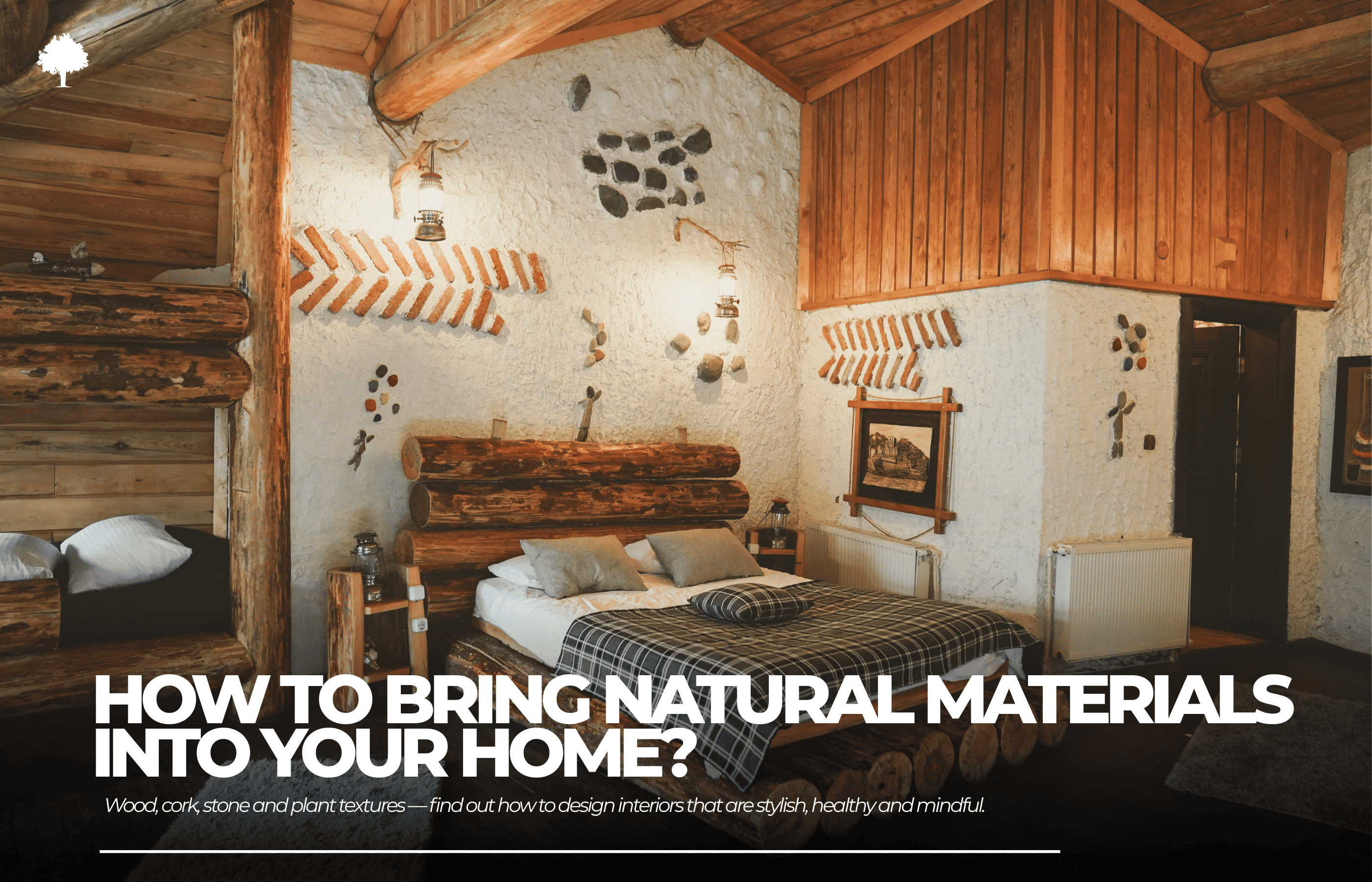
One of the key trends in contemporary interior design is a return to natural materials – resources that not only age beautifully, but also contribute to a healthier indoor microclimate.
In this article, we explore how to introduce natural materials into interiors in a conscious and stylish way – not only for visual effect, but also with comfort, durability and sustainability in mind.
Table of Contents
1. Introduction
2. Why surround yourself with natural materials?
3. Wood
4. Natural cork
5. Stone, ceramics, clay
6. Rattan, bamboo, wicker
7. Summary
8. FAQ
Why surround yourself with natural materials?
The impact of nature on mental well-being and health
Numerous scientific studies confirm that contact with nature – even indirect contact through materials and textures – has a positive effect on our well-being. Natural resources such as wood, stone or organic textiles introduce a sense of calm, balance and warmth into interiors. Their presence can help reduce stress levels, improve concentration and even support better sleep.
Biophilic design – what is it and why is it gaining popularity?
Biophilic design is an approach that places the human–nature relationship at the centre of the design process. It involves integrating natural elements – not only materials, but also daylight, greenery, organic forms and colours – into residential and commercial spaces. In practice, this means more than choosing a wooden floor over a vinyl one; it also means using materials that breathe, respond to their environment and develop a refined patina over time. The popularity of this approach is growing among people seeking deeper comfort – not just visual, but also sensory and emotional.
Natural materials as a response to excess plastic and synthetics
For decades, interiors were shaped largely by synthetic materials – plastics, laminates and artificial composites. While often convenient and inexpensive, they rarely offer the depth of experience or longevity provided by natural materials. Choosing natural resources is therefore not only an aesthetic decision, but also a statement of values: care for the environment, health and authenticity.
Wood
Wood is one of the most versatile and noble materials, accompanying humanity for centuries in construction and interior design. Its natural grain, colour variations and warmth add depth, elegance and a sense of comfort to interiors. However, the properties of wood vary depending on the species, treatment method and intended use. Carefully selected wood can last for decades, impressing not only with its appearance but also with its functionality.
Which wood species work best in different rooms?
The choice of wood species should reflect both the conditions of a given space and its intended function:
-
Oak – exceptionally durable and resistant to wear and moisture. Ideal for floors, kitchen worktops and functional furniture. Its elegant grain works well in both classic and modern interiors.
-
Ash – light-coloured, flexible and slightly springy. It performs well in areas with moderate use, making it suitable for bedrooms and home offices.
-
Walnut – darker and highly decorative. Often chosen for living rooms or representative spaces where a sense of luxury is desired.
-
Larch and pine – softer species that work well in relaxation areas such as bedrooms or children’s rooms, adding warmth and natural charm.
In bathrooms or kitchens, where humidity levels are higher, it is worth considering exotic species such as teak or merbau, which are naturally resistant to moisture.
Raw vs. oiled – finishing makes a difference
The way wood is protected affects not only its appearance, but also its durability and everyday performance:
-
Raw wood stands out for its authenticity and natural scent, but requires more care, as it easily absorbs moisture and stains.
-
Oiling preserves the natural look of wood while protecting it from water and mechanical damage. The oil penetrates deep into the structure without forming an artificial layer, allowing the surface to breathe.
-
Varnishing provides greater resistance to scratches, but creates a coating that may alter both the tactile feel and visual perception of the wood.
The type of finish should be matched to the area of use – in high-traffic zones, oiling often offers a good balance between aesthetics and practicality.
Small accents, big impact: shelves and frames
Introducing wood into an interior does not necessarily require a major renovation or expensive furniture replacement. Often, subtle details are enough to significantly change the character of a space:
-
Wooden shelves – simple in form, wall-mounted or supported by brackets, they add depth and functionality.
-
Solid wood picture or mirror frames can serve as decorative features in their own right, adding refinement even to minimalist interiors.
-
Wooden handles, chopping boards, lamps or crates – small details that make a space feel cohesive and more human in character.
Such elements are an excellent starting point for those who want to experiment with natural materials without committing to major changes.
Natural cork
Although for many years associated mainly with notice boards or bottle stoppers, natural cork has made a strong comeback as a fully fledged finishing and decorative material. It is lightweight, flexible, moisture-resistant and exceptionally eco-friendly. Visually, it works equally well in modern and more traditional interiors, offering unique functional and health-related benefits.
What is cork?
Cork is a material obtained from the bark of the cork oak (Quercus suber), most commonly found in the Mediterranean region. The harvesting process is completely non-invasive – the tree is not cut down, and the bark regenerates every few years, allowing repeated harvesting over several decades. Thanks to its cellular structure (millions of microscopic air-filled cells), cork is extremely lightweight, elastic and resistant to pressure and temperature fluctuations.
Applications: from walls to accessories – far beyond notice boards
Natural cork can be used in many forms and locations, far beyond its traditional applications:
-
Wall coverings – cork on walls provides not only a striking visual effect, but also natural acoustic and thermal insulation. It works particularly well in bedrooms, children’s rooms and home offices.
-
Floor panels – flexible, warm underfoot and effective at reducing footstep noise. Cork flooring combines everyday comfort with modern design.
-
Accessories and décor – coasters, furniture and design objects show how cork is increasingly valued as a stylish and practical decorative material.
Why is cork eco-friendly and healthy for household members?
Cork is a fully natural, biodegradable and renewable material. Its production involves a minimal carbon footprint – trees are not damaged, and their presence increases the absorption of carbon dioxide from the atmosphere. Moreover, cork does not emit volatile organic compounds (VOCs), which are often found in synthetic materials and may have a negative impact on health.
Thanks to its antistatic and antibacterial properties, cork is an excellent choice for allergy sufferers and families with young children. It does not attract dust, does not retain moisture, effectively dampens noise and helps regulate the indoor microclimate. It is a material that supports healthy, conscious and comfortable living – both in urban environments and beyond.
Stone, ceramics, clay
Materials sourced directly from the earth – such as stone, clay and ceramics – have accompanied humanity in building and shaping spaces for thousands of years. Today, they return in a renewed form: refined, minimalist and exceptionally durable interior elements.
Where does stone work best?
Natural stone such as marble, granite, travertine or slate performs best wherever durability, a luxurious appearance and resistance to heavy use are required. Common applications include:
-
Kitchen and bathroom worktops – granite and marble are timeless choices, offering both visual appeal and resistance to heat and scratches.
-
Floors and staircases – stone retains its character over time, lending interiors elegance and a raw, natural charm.
-
Wall cladding and fireplaces – particularly in living rooms and halls, where stone can serve as a strong design statement.
-
Outdoor elements – façades, terraces and garden paths made of stone seamlessly connect the home with its surroundings.
Stone is an investment for years to come – resistant to changing trends and synonymous with durability and prestige.
Clay in modern interiors: plasters, ceramics, lighting
Clay, often perceived as a “primitive” material, is making a strong comeback in architecture and design. Its malleability and warm character make it an excellent base for contemporary finishing solutions:
-
Clay plasters – a natural alternative to smooth finishes and paints. They regulate humidity, are antistatic and breathable, and their matte, deep finish makes them ideal for bedrooms and living rooms.
-
Functional and decorative ceramics – hand-formed bowls, vases or tiles act as authentic decorative elements that highlight the individuality of an interior.
-
Clay lamps and shades – thanks to its gently porous structure, clay softens light and adds warmth, creating a cosy atmosphere.
Clay is a raw yet refined material that pairs beautifully with wood, linen and metals, fitting seamlessly into both rustic and minimalist styles.
Rattan, bamboo, wicker – nature in a lightweight form
Not all natural materials need to feel heavy or raw. Rattan, bamboo and wicker bring lightness, airiness and delicacy to interiors while maintaining durability and functionality. They are an excellent choice for those looking to introduce nature in a subtle yet noticeable way – both in urban apartments and holiday homes.
Key differences between the materials – what’s worth knowing?
Although rattan, bamboo and wicker are often used interchangeably, they differ in origin, properties and typical applications:
-
Rattan
Derived from rattan palms growing in tropical regions of Southeast Asia. It is flexible, durable and easy to shape, making it ideal for woven furniture such as armchairs, chairs, sofas and screens. Rattan retains its natural look even after varnishing, and its weaves add texture and visual interest. -
Bamboo
Technically a grass rather than wood, bamboo is exceptionally strong and fast-growing. Its high resistance to moisture makes it suitable for kitchens, bathrooms, flooring and wall cladding. Its clean, uniform structure works well with minimalist design. -
Wicker
Made from young, slender willow shoots, wicker is especially popular in handicrafts, baskets, lampshades, plant covers and small furniture. It is more delicate than rattan, yet equally decorative, and works best in natural, boho or vintage-inspired interiors.
Each of these materials carries a different aesthetic expression: rattan feels more colonial and classic, bamboo leans towards a raw, modern look, while wicker conveys a homely and cosy character. The right choice depends on the nature of the interior and personal preferences.
Summary
Introducing natural materials into interiors is more than a trend – it is a conscious choice that brings aesthetic, health and environmental benefits. Wood, natural cork, stone, clay, rattan, bamboo and wicker are materials that tell a story of humanity’s connection with nature, while offering functionality and timeless style.
In an age of synthetic overload and constant rush, natural materials provide a counterbalance – offering calm, authenticity and longevity. Thanks to them, a home becomes more than just a functional space; it turns into an environment that supports regeneration, nurtures relationships and fosters harmony with its surroundings.
FAQ – Frequently asked questions
1. Do natural materials work well in modern interiors?
Absolutely. Although rooted in tradition, natural materials integrate seamlessly with modern design. With the right choice of form, finish and colour palette, wood, natural cork, stone, clay or bamboo can enhance a minimalist interior, add warmth or act as a subtle counterpoint to cooler surfaces.
2. Do natural materials require special care?
Some of them – such as wood or clay – do require a little more attention than synthetic materials, but their maintenance is not complicated. Regular oiling of wood, proper sealing of clay surfaces or avoiding excess moisture in the case of wicker allows you to enjoy their beauty and durability for many years. In return, they offer a level of quality that synthetic alternatives simply cannot match.
3. Does investing in natural materials mean higher costs?
At the purchasing stage – often yes. Solid wood, natural cork or stone tend to be more expensive than synthetic substitutes. However, in the long term, this investment pays off – not only because of durability, but also due to increased property value. Natural materials age gracefully, require replacement less frequently and never go out of style.
4. Can different natural materials be combined in one interior?
Yes – and it is highly recommended. The key lies in maintaining colour harmony and balanced proportions. For example, cork flooring can work beautifully with a stone worktop, linen curtains and wicker accessories. Natural materials complement one another both in texture and aesthetics, creating a cohesive and welcoming space.


