



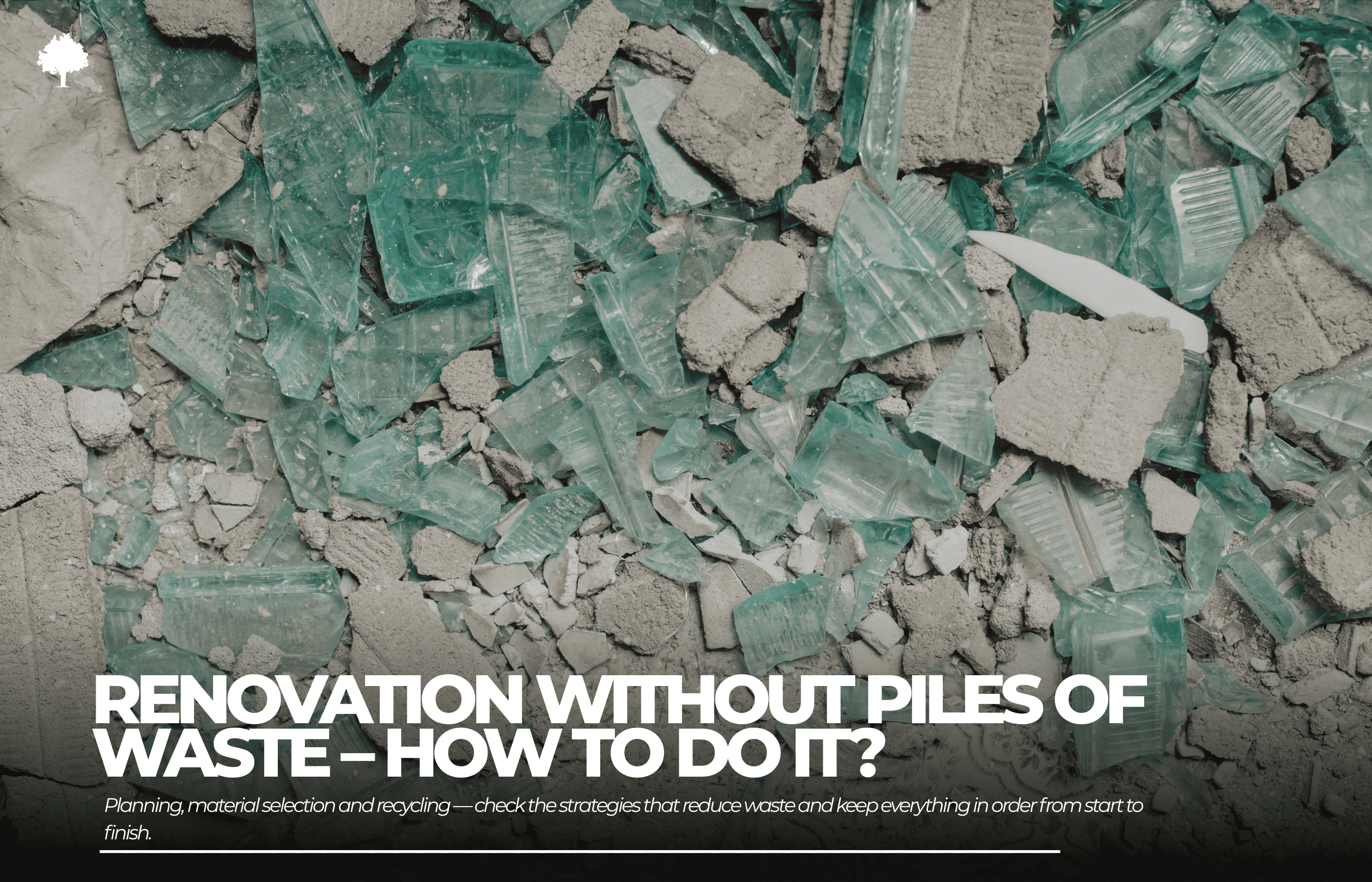
Even the most carefully planned interior renovation often ends the same way – with piles of rubble, cardboard, packaging from building materials and leftover waste that is time-consuming, costly and unpleasant to dispose of.
Is it possible to carry out a renovation without generating tons of waste? Can high aesthetic standards be combined with environmental responsibility and practical logistics? The answer is yes. The key lies in proper planning and making conscious choices when it comes to materials and technologies.
In this article, we take a closer look at proven ways to complete a renovation with minimal waste – efficiently and responsibly.
Table of Contents
1. Introduction
2. Why do renovations generate so much waste?
3. Smart planning
4. Recycling before renovation: what can be saved, restored or sold?
5. Smart shopping – how to buy without throwing things away
6. Summary
7. FAQ
Why do renovations generate so much waste?
The scale of the problem in numbers
Apartment and house renovations are one of the main sources of construction waste in Poland. According to data from the Central Statistical Office, around 13.4 million tonnes of municipal waste were generated in Poland in 2023, with construction and demolition waste accounting for a significant share. While the development sector produces the largest volumes, it is often small-scale renovation projects – carried out en masse in thousands of homes – that are the least efficient in terms of waste management.
What ends up in the containers?
The most common renovation waste includes:
-
Rubble – concrete, bricks, plaster, pieces of plasterboard
-
Finishing materials – old panels, carpets, tiles, wallpaper
-
Packaging waste – plastic foil, polystyrene, cardboard from paints and adhesives
-
Worn fixtures and joinery – doors, windows, radiators, bathroom ceramics
-
Leftover building materials – unused paints, adhesives, mortars
In many cases, all of this waste ends up in a single container without any sorting, which drastically limits the possibility of recycling or reuse.
Environmental awareness vs. on-site reality
More and more people declare a desire to renovate in a sustainable way, choosing recycled products or materials with environmental certifications. However, there is often a significant gap between intention and execution.
There are several reasons for this:
-
Lack of standards among contractors – few offer waste sorting or material recovery services.
-
Time pressure – fast renovations often rule out “zero waste” logistics.
-
Lack of infrastructure – in many areas there is no access to selective collection points, and renting multiple containers adds extra cost.
-
Poor purchasing organisation – ordering excessive amounts of building materials results in large volumes of waste from the very start.
As a result, despite good intentions, many renovations end in the same way – with a container full of mixed waste that ultimately goes to landfill.
Smart planning
Precision instead of improvisation
One of the most important factors influencing the amount of renovation waste is how the project is planned. Renovations carried out “by eye” almost always result in surplus materials, unnecessary purchases and the disposal of perfectly usable products. A well-designed renovation, by contrast, means less stress, lower costs and significantly less waste.
Already at the concept stage, it is worth:
-
Preparing a detailed design that anticipates material quantities and matches them to real needs.
-
Carrying out a space inventory – precise measurements help avoid ordering mistakes and the need for corrections.
-
Consulting with the contractor – an experienced professional can advise on how to optimise material use and avoid losses during cutting, installation or assembly.
Shopping with care
Too often, investors buy extra materials “just in case”, without considering that unused products are rarely returnable – especially if they are sold loose or damaged during transport.
Instead:
-
Calculate requirements precisely – based on the design, add a 5–10% margin, not 30%.
-
Choose products sold by the metre, not by the package – this helps avoid leftovers and unnecessary surplus.
-
Check return policies – choose suppliers that allow unused materials to be returned without extra charges.
Avoid “construction FOMO”
Many investors follow the rule “better too much than too little”, which in practice means dozens of kilos of unused tiles, excess paint or tens of metres of skirting boards. This approach generates not only costs, but also physical waste that is difficult to dispose of or resell.
Instead, it is worth following a simple principle: measure twice, buy once – and only what you truly need.
Recycling before renovation: what can be saved, restored or sold?
Before the first hammer hits the wall, it is worth taking a close look at what is already in the house or apartment. What many people consider rubble or scrap often has real value – functional, aesthetic or material. This is not only a way to reduce waste, but also an opportunity to highlight the character of the interior and introduce unique details.
A second life for old elements
Many furnishings can be given a second life – with clear benefits for both the budget and the environment. The most commonly recovered or refurbished items include:
-
Doors – solid wood doors, once restored (for example by sanding and repainting), gain a refined look that modern board-based doors cannot match.
-
Windows – older wooden frames can often be sealed and restored. In the case of historic joinery, this may even be a conservation requirement.
-
Tiles – old cement or ceramic tiles, especially those in good condition, are now sought-after decorative materials.
-
Cast-iron radiators – classic radiators, once sandblasted and repainted, become striking features in retro or industrial interiors.
Some elements that no longer fit the new aesthetic vision can still find a second life – not necessarily in our own home.
Smart shopping – how to buy without throwing things away
Shopping is one of the most important stages of any renovation – not only in terms of aesthetics and budget, but also ecology. Decisions made at this point have a direct impact on the amount of waste generated during and after the work.
Choose materials that can be dismantled and reused
Some materials – although attractive in price – are designed for single use. Their removal leads to complete destruction, meaning that after years of use they end up only in landfill. Instead, it is worth investing in:
-
Click-installed floor panels and boards – which can be laid again.
-
Modular kitchen and furniture systems – easy to dismantle and modify.
By choosing solutions suitable for future recycling or dismantling, we invest not only in durability, but also in flexibility for future changes – without generating piles of rubble.
Reducing packaging: less plastic, fewer problems
A huge proportion of post-renovation waste consists of packaging from building materials. Stretch film, plastic buckets from adhesives and paints, and protective polystyrene all end up in the container on the very first day of work.
To limit this category of waste:
-
Choose products in bulk or reusable packaging, such as paints in metal cans instead of plastic.
-
Use local suppliers and builders’ merchants, where many products are sold loose or packaged with minimal plastic.
-
Order to size – for example, boards cut to measure, which reduces material surplus and transport packaging.
A conscious choice of supplier can sometimes result in greater savings than a supermarket promotion, once disposal costs and excess materials are taken into account.
The role of natural materials: durability, aesthetics, less waste
Natural raw materials such as wood, stone or cork are increasingly returning to favour in modern interiors. They are not only environmentally friendly, but also highly practical when the goal is to reduce waste.
For insulation or finishing, it is worth considering natural cork – a biodegradable, durable material that is lightweight and easy to install, reducing losses during cutting and limiting waste. Natural cork does not produce dust, does not crumble and can be installed without specialist tools. What is more, cork panels can often be recycled or reused in other interiors.
By investing in natural materials, we invest not only in aesthetics, but also in quality and the ecological footprint of the renovation – one that will stay with us for years, both literally and figuratively.
Summary
A renovation without mountains of waste is not just a trendy slogan, but a real possibility – especially for investors who expect high quality, comfort and at the same time want to act responsibly. The key is awareness and planning: from precise design, through sensible purchasing, to making use of what we already have.
As we have shown, reducing waste does not have to mean aesthetic or functional compromises. On the contrary – it can lead to more refined, individual and long-lasting solutions. Recycling, renovation, choosing second-life materials, and investing in natural raw materials such as natural cork make it possible to carry out a renovation in the spirit of modern luxury: elegant, conscious and environmentally responsible.
FAQ
1. Are natural materials always more environmentally friendly?
Not always – it depends on the source and the production process. However, well-chosen natural raw materials such as cork, wood or wood wool have a lower carbon footprint, are biodegradable and easy to reuse. Natural cork stands out in particular as a durable, lightweight and almost waste-free material.
2. Is an eco-friendly renovation more expensive?
Not necessarily. While natural or renewable materials can be more expensive per unit, lower disposal costs, greater durability and the possibility of recycling make them cost-effective in the long run. In addition, by reducing waste and avoiding unnecessary purchases, it is possible to significantly lower the overall renovation budget.


