



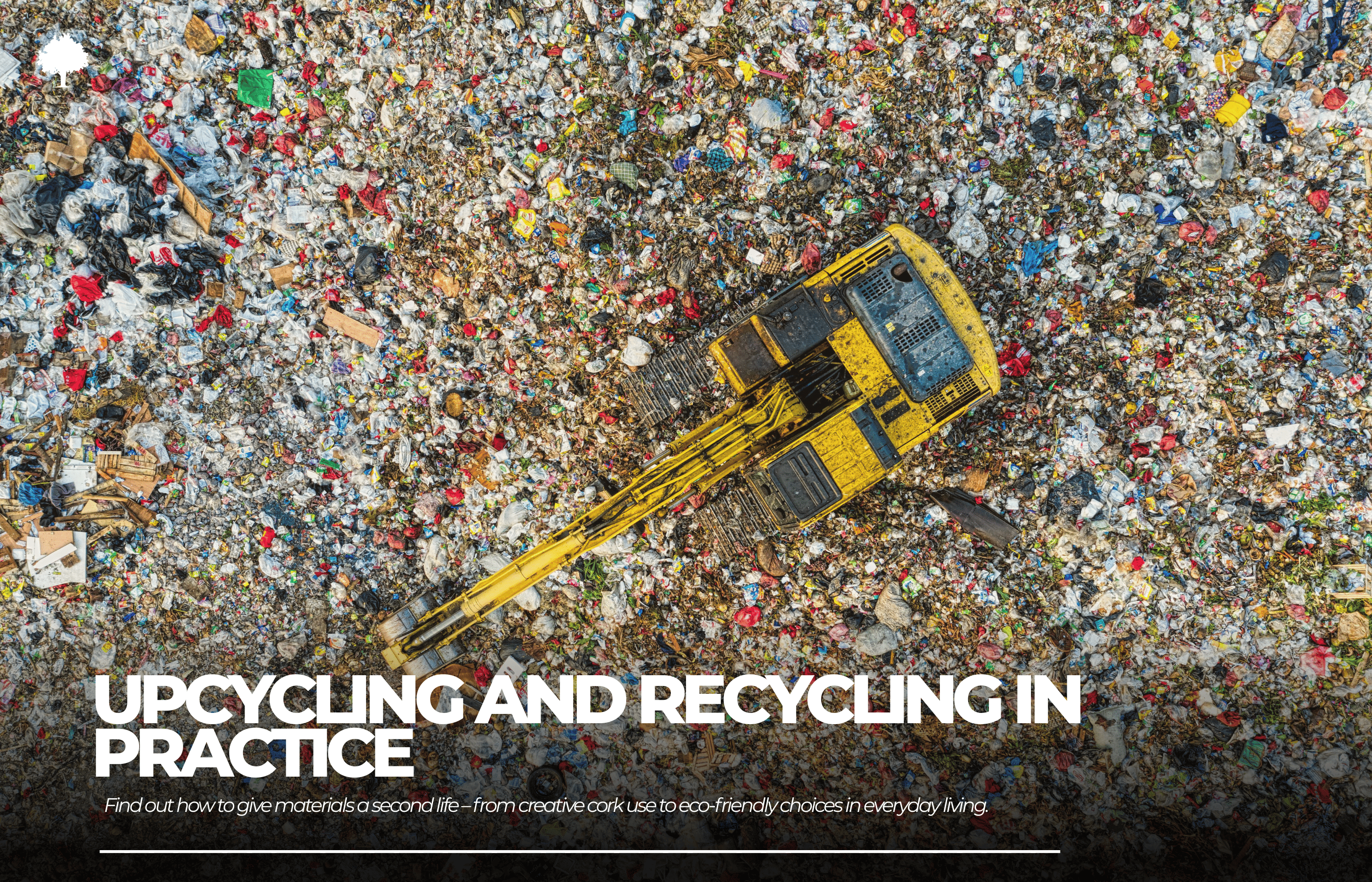
The climate crisis, the overproduction of waste, and the depletion of natural resources mean that the way we buy, use, and dispose of objects has a direct impact on the condition of our planet.
Two key concepts are gaining increasing importance: recycling and upcycling. Although they are often used interchangeably, they differ not only in definition but, above all, in practical application and environmental impact.
In this article, we explain the difference between recycling and upcycling, outline practical actions that the average consumer can take, and show how to incorporate these practices into everyday life—without compromising on style, comfort, or prestige.
Table of contents
1. Introduction
2. Why are upcycling and recycling so important today?
2. Recycling and upcycling – how do they relate to interior design?
4. Natural cork – recycling potential
5. Summary
6. FAQ
Why are upcycling and recycling so important today?
The difference between recycling and upcycling
Recycling is the process of transforming used materials into secondary raw materials that can be reused to manufacture new products.
Upcycling, unlike recycling, involves creatively transforming unwanted or worn-out items into products with higher aesthetic or functional value. A classic example is turning old doors into a designer table.
The key difference therefore lies in the outcome: recycling preserves the material but not necessarily its value, whereas upcycling creates a new quality and often a higher value than the original form.
The waste crisis and its environmental impact
More than 2 billion tonnes of municipal waste are produced worldwide every year, a significant portion of which ends up in landfills—or worse, in the natural environment. Plastic waste accumulates in oceans, microplastics enter the food chain, and uncontrolled waste incineration contributes to the emission of harmful greenhouse gases.
Rising consumption levels, particularly in developed countries, only exacerbate the problem. Products are often designed with a short life cycle in mind: they wear out quickly or go out of fashion. This is the so-called linear economy—the “buy–use–discard” model—which overloads waste management systems and leads to environmental degradation.
How everyday choices can make a difference
Change begins with the individual—every purchasing decision is a vote for a particular economic model. By choosing recycled products, repairing instead of discarding, or supporting brands that promote upcycling, we influence the entire value chain.
How to apply this in practice?
Introducing recycling and upcycling into interior design does not require a revolution—well-considered decisions are enough:
-
Reclaimed furniture: Renovating old chests of drawers, wardrobes, or tables can give an interior real character. High-quality wood from past decades often surpasses modern mass-produced furniture in both durability and appearance.
-
Upcycling materials: Transport pallets turned into garden sofas, wine crates repurposed as shelves, old doors used as headboards—the possibilities are almost endless.
-
Details and accessories: Lamps made from old bicycle parts, cushions from recycled linen, rugs from processed textiles—these elements add depth and a story to an interior.
What matters is not only owning unique items, but also knowing their story. This is what makes a home feel conscious and authentic.
Common mistakes when making choices
Despite the best intentions, some decisions can have the opposite effect to what was intended:
-
Aesthetics over functionality: Not every reclaimed item is suitable for everyday use. An old chair may look stunning, but if it is unstable, it will serve more as decoration than as furniture.
-
An overly random style: Too much eclecticism can turn a space into a collection of unrelated elements. Recycled and upcycled items should be integrated into a coherent overall design concept.
-
Lack of material verification: Old paints or varnishes may sometimes contain harmful substances (such as lead). Before renovation, it is worth checking the origin and composition of materials.
What should guide your choices?
The key to an elegant and responsible interior lies in quality, authenticity, and naturalness. When selecting materials and elements, it is worth:
-
Choosing natural raw materials – natural cork, wood, linen, stone, wool, or ceramics not only age beautifully but are also safe for health and the environment.
-
Supporting local craftsmen and producers – a way to strengthen regional economies and obtain truly unique items.
-
Maintaining balance – the goal is not for everything to be reclaimed, but to consciously combine new and old elements into a harmonious whole.
Natural cork – recycling potential
Natural cork is a material that has gained recognition in recent years not only among interior designers but also among environmentally conscious consumers. It combines an eco-friendly character with outstanding functional properties and impressive recycling and upcycling potential.
What is natural cork and where does it come from?
Natural cork is obtained from the bark of the cork oak (Quercus suber), a tree growing mainly in the Mediterranean region—particularly in Portugal, Spain, and Italy. Crucially, harvesting does not involve cutting down the tree: the bark is removed by hand every 9–12 years, while the tree continues to grow for many decades. This makes cork one of the most sustainable natural raw materials available on the market.
The properties of cork make it an exceptionally versatile material:
-
it is lightweight, flexible, and moisture-resistant,
-
it has natural antifungal and antibacterial properties,
-
it provides effective thermal and acoustic insulation,
-
it is pleasant to the touch and visually warm.
Thanks to these qualities, cork performs well not only as a sealing material (e.g. in bottles or industrial applications), but also as a decorative and functional element in interior architecture—in the form of wall panels, flooring, accessories, or furniture.
What does cork recycling offer?
Recycling cork is not only a way to reduce waste, but also an opportunity to give the material a new life in an environmentally friendly manner. Cork is ground and processed into granulate, which can be used, among other things, to produce:
-
insulation and acoustic boards,
-
floor underlays and wall panels,
-
technical cork products,
-
components for furniture and decorative items,
-
as well as everyday products—coasters, notebooks, and even footwear.
In addition, upcycling cork opens the door to creative solutions—for example, mosaic wall decorations or jewellery.
It is also worth emphasising that cork recycling does not require high energy input or harmful chemical processes, making it an even more environmentally friendly solution than the conventional recycling of synthetic materials.
Summary
Recycling and upcycling are not passing trends, but practical tools in the fight against the environmental crisis that—when applied thoughtfully—can become an integral part of everyday life. The distinction between recycling and upcycling—between reusing materials and creatively transforming them—creates space not only for environmental responsibility, but also for aesthetics, uniqueness, and quality. Change begins with small choices: selecting materials, rethinking our relationship with objects, and taking care of what we already own.
FAQ – Frequently asked questions
1. Is every material suitable for recycling or upcycling?
Not all materials are suitable. Recycling requires clean raw materials and appropriate infrastructure. For example, multilayer packaging (such as juice cartons) is difficult to process. Upcycling, on the other hand, relies on creativity and depends on the technical condition of the material. In practice, the greatest potential lies in wood, metal, glass, natural textiles, and natural cork.
2. Does upcycling have to mean a rustic or boho style?
Absolutely not. While these styles often highlight reclaimed elements, upcycling can also align with minimalist, industrial, Scandinavian, or modern aesthetics. What matters most is form, colour palette, and craftsmanship. Even a recycled item can look refined and exclusive.


