



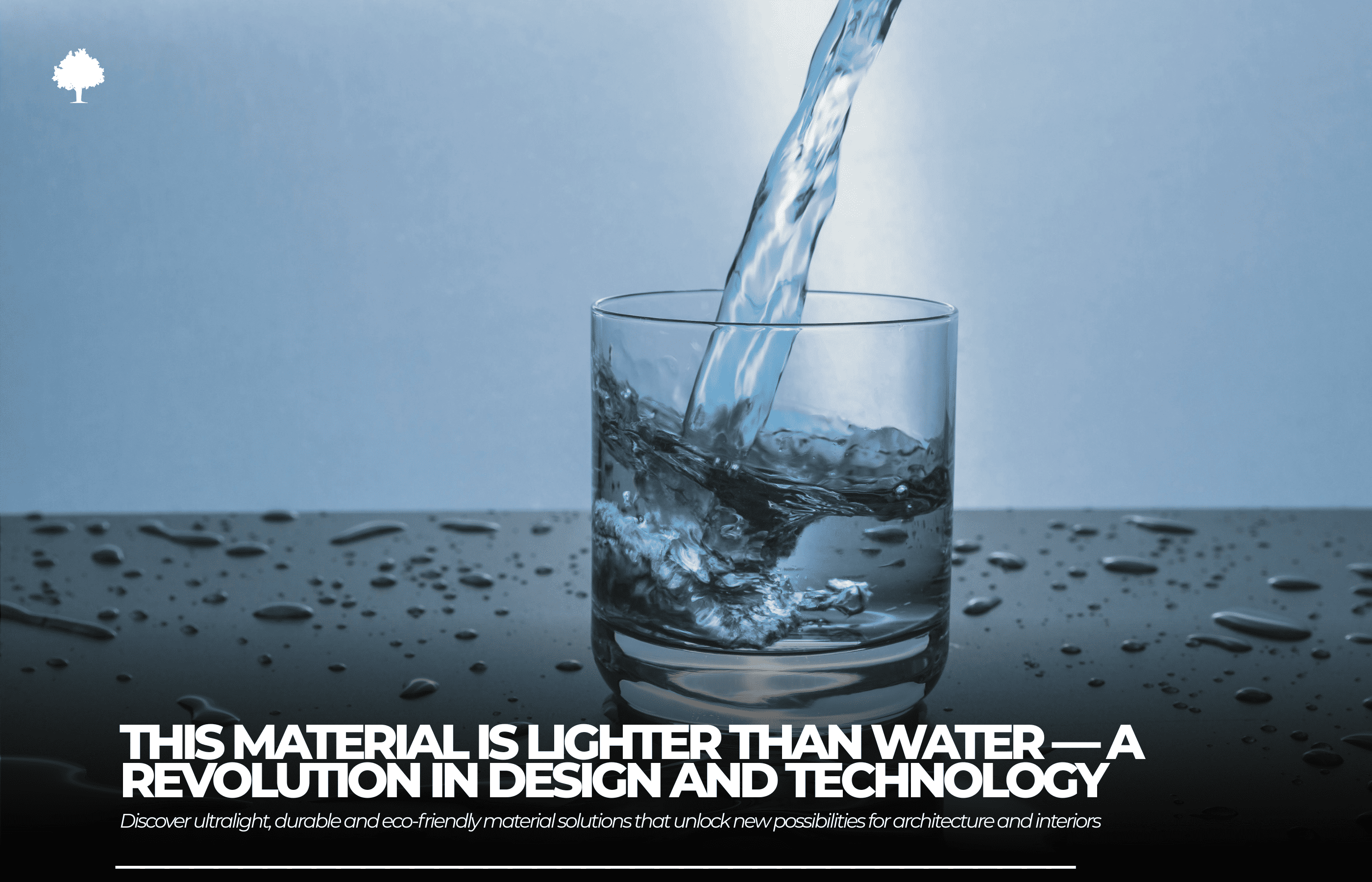
Imagine a material that is lighter than water. Not metal, not a futuristic lab-made plastic, but something entirely natural. Something most of us have held in our hands hundreds of times — without ever thinking about it this way. Sounds like a trick question or a quiz riddle? And yet, it’s a fact.
In a moment, we’ll show how it’s possible for something to be lighter than water — and why this fact changes far more than just the way we look at this seemingly ordinary material.
Table of Contents
1. Introduction
2. How can something be lighter than water?
3. Water versus…
4. Lightness that matters in practice
A smooth transition from curiosity to real benefits: what low weight means in everyday use.
5. Lightness = Practicality
6. Summary
7. FAQ
How can something be lighter than water?
At first glance, it sounds illogical. Water seems “light”, fluid, almost weightless. And yet, whether something sinks or floats doesn’t depend on how heavy it feels in your hand, but on something much simpler.
It all comes down to density — in other words, how much “material” is packed into a given volume. Put simply:
if two objects are the same size but one weighs less, that one has a lower density.
Water has its own fixed benchmark — a unit density. Anything denser than water sinks. A stone, a metal key or a coin — even if small — will drop straight to the bottom. Materials with a density lower than water behave in the opposite way: they float. It’s not the size that matters, but how tightly mass is packed inside the material.
And this is exactly where the story of a material that is surprisingly lighter than water begins — and does so in a way that’s hard to match.
Water versus… natural cork (1:0 for cork)
If we staged a very simple “duel” comparing water and natural cork of the same size, the result would be clear — and without any suspense.
Water has a density of 1 g/cm³. Natural cork, by contrast, reaches only about 0.12–0.20 g/cm³. What does this mean in practice? That the same volume filled with cork can weigh several times less than the same volume filled with water.
In other words, natural cork is simply lighter than water. Not “slightly”, not “under the right conditions”, but clearly and undeniably. That’s why, once placed in water, it doesn’t hesitate — it immediately rises to the surface, as if that’s exactly where it belongs.
The secret of cork: an air-filled structure
Where does this remarkable lightness come from? The answer lies inside — quite literally.
Natural cork has a microscopic cellular structure, similar to a honeycomb or a very dense foam. Each of these tiny cells is sealed by elastic walls and filled with air.
The result? As much as 80–90% of cork’s volume is air. That’s what does the heavy lifting — dramatically reducing the material’s weight without compromising its shape or durability.
Why does cork always float?
When you combine these two factors — low density and a structure filled with trapped air — the answer becomes obvious. Natural cork doesn’t sink because it simply can’t. As a whole, it’s lighter than water.
That’s why cork always returns to the surface, doesn’t absorb water, doesn’t lose its properties and doesn’t behave like a soaked sponge. This isn’t a trick or an exception — it’s a natural consequence of its structure.
And it’s precisely this apparent “lightness” that will soon reveal itself as a feature with very real importance in everyday life.
Lightness that matters in practice
Up to this point, the lightness of natural cork may have sounded like a fun fact — something surprising, nice to remember. But in practice, low weight isn’t an anecdote, it’s a very tangible advantage you feel every day.
A lighter material means easier handling, installation and everyday use. Cork products don’t strain your hands, walls or the structures they’re attached to. They can be mounted where other materials would require heavy-duty anchors, reinforcements or, quite simply… compromises.
Lightness also improves comfort. Items you lift, move or carry regularly stop being a burden. They don’t tire you out, don’t pull you down and don’t constantly remind you of their presence. It’s a small detail that quickly starts to make a big difference.
There’s one more aspect that often goes unnoticed: safety. Lighter elements mean a lower risk of damage, injury or breakage if something falls. That’s why natural cork has long been used wherever functionality must go hand in hand with peace of mind.
At this point, lightness stops being an abstract physical property and starts working in very practical ways. Because when a material weighs little, you can do far more with it — without making life more complicated.
Light natural cork in practical products
The advantages of cork’s lightness become most apparent when it stops being a “material” in theory and starts working in finished products. Wherever we install, carry or move something every day, low weight quickly proves to be a major asset.
Interiors: boards, panels and furnishing elements
Cork notice boards and wall panels are a perfect example of how low mass translates into comfort. They are easy to install, don’t overload walls and don’t require complex fixing systems. They can be used in homes, offices and educational spaces — even where wall structures are more delicate.
Light natural cork also means greater design flexibility. Elements can be moved, replaced or expanded without mess or costly alterations. Add to that acoustic comfort and a pleasant, natural feel to the touch — qualities that are increasingly valued in contemporary interiors.
The lighter the material, the greater the possibilities
Cork’s low weight opens the door to projects that would be difficult or uneconomical with heavier materials. Lightweight claddings, mobile partitions, modular systems or large-format decorative elements all become feasible precisely because natural cork doesn’t add unnecessary kilograms.
For designers and users alike, this means one thing: more freedom. Fewer technical constraints and more room for function, aesthetics and creative ideas.
Cork accessories: when every gram matters
In everyday items, lightness can be crucial. Wallets, organisers or cases made from natural cork are noticeably lighter than leather or plastic alternatives, while remaining durable and comfortable to use.
When you carry something with you all day, even a difference of a few grams becomes noticeable. Cork excels here — it doesn’t weigh down your pocket or bag, yet keeps its shape and resists everyday wear.
Yoga mats and sports accessories
In sport and recreation, lightness goes hand in hand with performance. Yoga mats, rollers and other cork accessories are easy to carry, yet stable and resilient.
Thanks to its natural structure, cork insulates well from cold surfaces, doesn’t slip and remains comfortable even with intensive use. The combination of low weight, flexibility and insulating properties means this material is increasingly chosen wherever balance matters — both literally and figuratively.
That’s why the lightness of natural cork isn’t a textbook curiosity, but a real advantage in the products we use every day.
Summary
A material lighter than water sounds like a riddle — until you take a closer look at natural cork. Then everything falls into place. Its exceptionally low density, microscopic air-filled structure and natural resistance to moisture mean cork not only floats, but performs brilliantly in everyday use.
What initially surprises us quickly proves to be a practical benefit. Lightness translates into comfort, safety and design freedom — from interior elements and mobile accessories to sports equipment. No excess weight, no functional compromises.
FAQ
1. Why doesn’t natural cork sink, even after long exposure to water?
Because its structure consists of millions of microscopic, closed cells filled with air.
2. Can cork absorb water like a sponge?
No. Unlike a sponge, natural cork has no open pores, which is why it doesn’t soak up water.
3. Why is cork so light yet still durable?
This is the result of its structure. A high proportion of air reduces weight, while flexible, elastic cell walls ensure resistance to compression and damage.
4. Does cork’s lightness matter outside of water?
Absolutely. Low weight improves comfort, simplifies installation and transport, and allows designers to create products that would be problematic with heavier materials.
5. Where does cork’s lightness work best?
In interior fittings, everyday accessories, sports equipment and anywhere comfort, mobility and safety are key.


